
Radiant Barrier Installation Cost in Spring Valley, NV: What You’ll Actually Pay
Radiant barrier installation in Spring Valley typically runs $600-$1,200 for a 1,400 sq ft attic deck using rafter-stapled perforated foil, installed. The exact number depends on rafter accessibility and how deep your existing insulation already sits. On Spring Valley’s slab-on-grade tract homes – many built between the mid-1980s and mid-2000s with original builder-grade batts – that range covers the work most homeowners actually need. Call (844) 320-7838 for a written price before any work starts; estimates are free.
Why we lead with a dollar figure: too many national cost guides publish a vague “$0.50 to $2.00 per square foot” and leave it there. In a Mojave Desert attic that regularly crosses 150°F, that tells you almost nothing. This page gives you the Spring Valley numbers, the two installation methods, and which one performs better under our summer sun.
The comparison that matters: rafter-stapled foil vs. blown-in radiant chips
Two install methods dominate radiant barrier work, and in Spring Valley they are not interchangeable. The right one depends on your attic layout and how much of the deck you can reach.
- Rafter-stapled perforated foil. A reflective sheet stapled to the underside of the roof rafters, facing down into the attic. It blocks radiant heat at the source – the roof deck – before that heat ever conducts into the insulation below. This is the winner for peak-day performance in Spring Valley, because our problem is solar gain from a high summer sun angle, not heat loss.
- Blown-in radiant-barrier chips. Reflective chips mixed into the loose-fill insulation on the attic floor. Cheaper and quicker to apply, and sometimes the only option in a fully finished attic where rafters are boxed in. But chips sit at the deck, not the roof, so they intercept radiant heat later in the transfer chain. Fine on a mild day. Less effective on a 112°F afternoon.
Our technicians have up to 24 years of experience reading Spring Valley attics, and the recommendation almost always lands the same way: staple to the rafters when the roofline is accessible, use chips only when a finished attic leaves you no path to the deck.
Why the 150°F attic changes the math
Adding R-value to an attic already running 150°F is a bit like putting a thicker lid on a pot that’s on high. The heat keeps coming. A radiant barrier stapled to the rafters cuts that source temperature by 20 to 30°F before the blown-in insulation below it ever has to work. That’s why we treat radiant barrier as the first defensible dollar in a Spring Valley attic upgrade, not an afterthought bolted onto an insulation job.
Perforated or non-perforated foil? The desert-specific call
Here’s a detail most generic pricing pages skip, and it matters in Spring Valley. Perforated foil has thousands of tiny pinholes that let vapor pass through. Non-perforated foil does not. In a humid climate, that difference is academic. In our arid Mojave climate, it’s a real spec decision: the rare monsoon-season moisture that gets into an attic can condense against non-perforated foil and get trapped between the foil and the decking. Over a few summers, that’s how you grow a moisture problem you didn’t have.
Our specification for this market is perforated foil. The performance loss versus solid foil is negligible; the moisture risk it removes is not. If a crew quotes you non-perforated foil for a Spring Valley attic, ask why. The answer should be specific to your roofline, not a stock line. For a closer look at how we handle the moisture side of attic work, see our page on Moisture & Radiant Barriers in Spring Valley.
What radiant barrier installation costs in Spring Valley – line by line
Every quote we write itemizes the work so you can see radiant barrier priced separately from blown-in insulation, air sealing, and removal. That way you decide which phase to fund first rather than swallowing one bundled number. The ranges below reflect typical Spring Valley attics:
| Line item | Typical cost (installed) |
|---|---|
| Rafter-stapled perforated foil, 1,400 sq ft attic deck | $600-$1,200 |
| Blown-in radiant-barrier chips (finished-attic retrofit) | $450-$900 |
| Air sealing (top plates, recessed can lights) | $300-$700 |
| Blown-in insulation upgrade to R-38+ | $1,100-$2,400 |
| Old insulation removal (if needed) | $500-$1,200 |
The rafter foil range swings widest because accessibility drives labor. A straightforward gable-roof tract home with open rafter bays sits near the bottom. A low-pitch roof with HVAC equipment crowding the deck pushes toward the top. On the older Spring Valley homes, we also account for settled batts near the eaves – the hottest edge of the ceiling often runs under-insulated right where the afternoon sun hits hardest.
How much does radiant barrier cost by attic size in Spring Valley?
Scale the ranges above fairly linearly: a 1,000 sq ft attic deck lands around $450-$850 for rafter foil, and a 1,800 sq ft deck runs $800-$1,500. Square footage is the biggest single variable, but ceiling height, number of roof valleys, and how much ductwork crosses the deck all move the number. A written quote is the only way to nail it down for your house.
What you get in writing, before anyone climbs a ladder
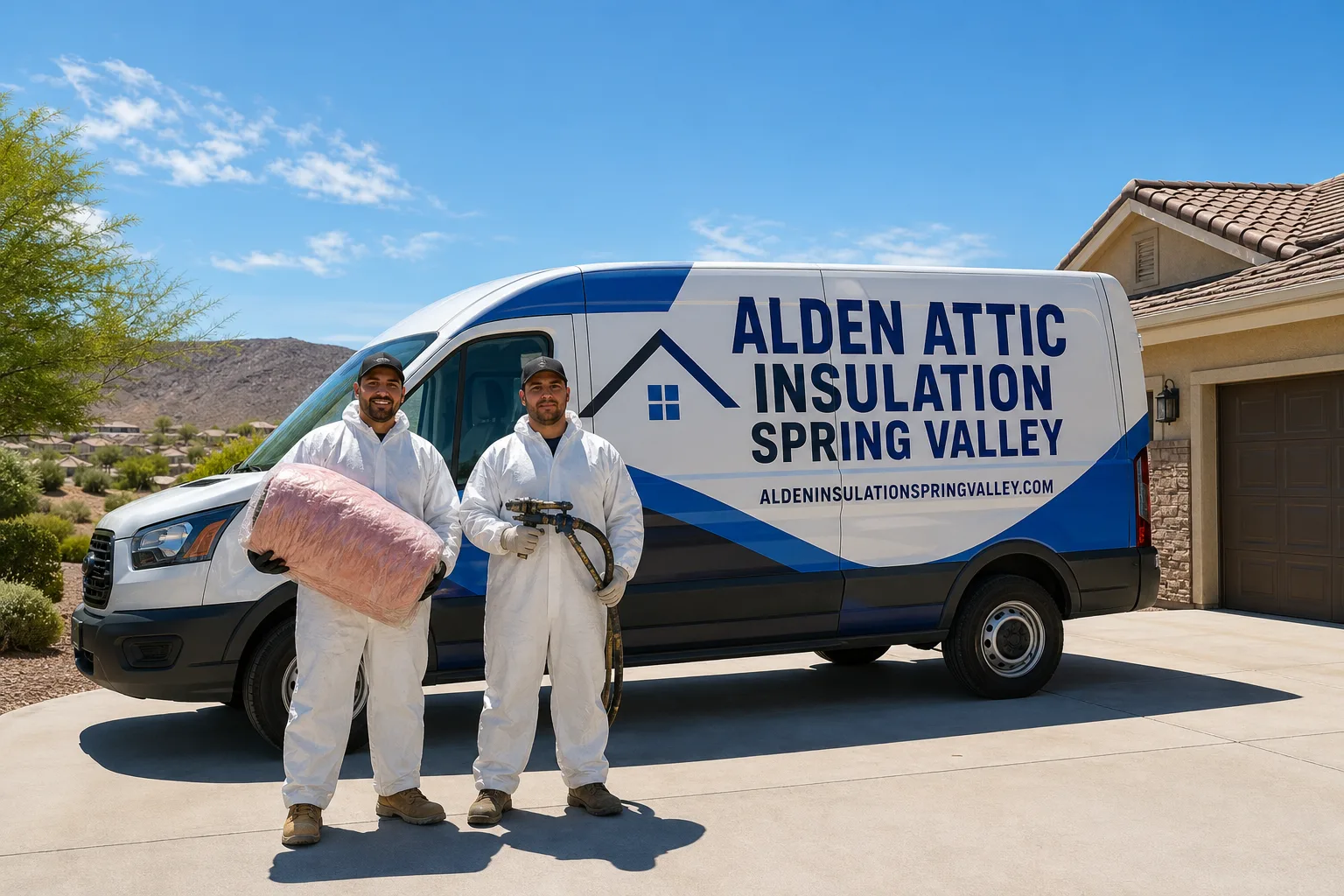
Alden Attic Insulation Spring Valley operates under The Garrison Standard: the written price is in your hand before a single tool comes off the truck, and the number you approve is the number on the invoice. Technicians are background-checked and arrive in uniform, inside the window we promised – not a vague half-day range. Calls are answered by a live person 24/7, not a form and not a voicemail.
Materials are ones you can look up on your own. We install from CertainTeed, GreenFiber, Icynene, and other industry-respected brands so you can research the spec sheet before you say yes. And every job carries our 365-Day Done Right Promise: a written guarantee for a full year. If the foil delaminates, tears at a staple point, or we find measurable gap coverage inside that window, we come back and re-staple at no charge. That commitment is in writing, which is more than most installers offer on foil work.
You can start from our home page to see how the whole attic upgrade fits together.
FAQs
Most Spring Valley homeowners pay $600-$1,200 for rafter-stapled perforated foil on a 1,400 sq ft attic deck, installed. Blown-in chip retrofits for finished attics run lower, around $450-$900. Call (844) 320-7838 for an exact written quote for your attic – estimates are free, and the price is in writing before work starts.
Yes, and it’s usually the highest-return dollar in a Spring Valley attic because it attacks radiant heat at the roof before that heat becomes conducted heat in the insulation. Adding R-value alone to an attic running 150°F doesn’t solve the source problem as efficiently. It cuts peak attic temperature 20 to 30°F, easing the load on your AC. Call (844) 320-7838 to see how it prices for your roofline.
Perforated foil is the safer spec for this market because its pinholes let monsoon-season moisture pass through instead of trapping it against the decking. Non-perforated foil can hold condensation in the rare humid stretch. Call (844) 320-7838 and we’ll spec the right foil for your attic – the written quote shows exactly what’s going up.
Often yes. Most Spring Valley radiant barrier installs are a single-day job when the rafters are accessible, and we schedule inside a window we commit to in writing. Call (844) 320-7838 – a live person answers around the clock, and you’ll have a free estimate and a start date in hand.
Get your written radiant barrier price
Before you add another inch of insulation to an attic that’s already cooking, find out what a radiant barrier costs for your specific Spring Valley home. Call (844) 320-7838 for a free estimate. You’ll get a written, itemized price, a background-checked crew in uniform, and the 365-Day Done Right Promise backing the work for a full year.
Written by the team at Alden Attic Insulation Spring Valley, serving Spring Valley, NV.
What Our Customers Say
"Tidy crew. Vacuumed the hall and covered the hatch."
- Bea J."Attic was uneven before and now every room is the same temperature."
- Gil N."Good job. Crew was an hour late the first morning, but finished everything in a day."
- Tim K.